

KLI Colloquia are invited research talks of about an hour followed by 30 min discussion. The talks are held in English, open to the public, and offered in hybrid format.
Join via Zoom:
https://us02web.zoom.us/j/5881861923?omn=85945744831
Meeting ID: 588 186 1923
Fall-Winter 2026/27 KLI Colloquium Series
1 October 2026 (Thurs) 3-4:30 PM CET 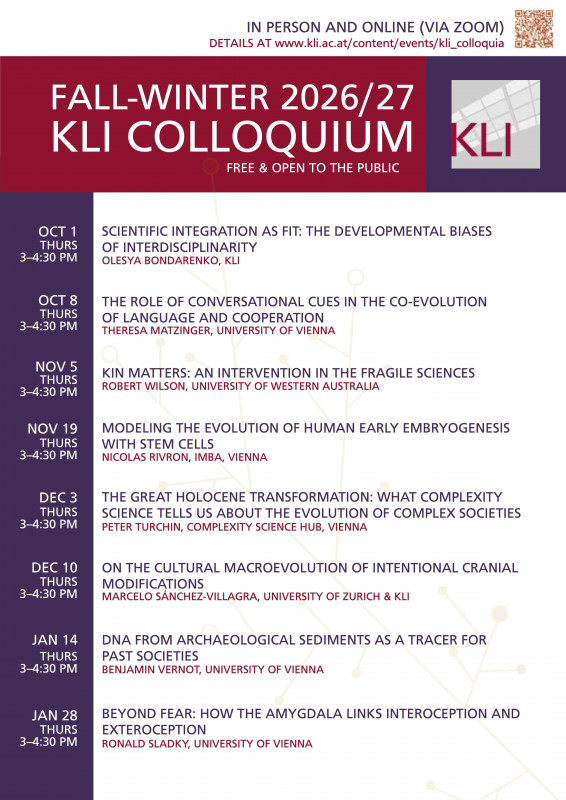
Scientific Integration as Fit: The Developmental Biases of Interdisciplinarity
Olesya BONDARENKO (KLI)
8 October 2026 (Thurs) 3-4:30 PM CET
The Role of Conversational Cues in the Co-Evolution of Language and Cooperation
Theresa MATZINGER (University of Vienna)
5 November 2026 (Thurs) 3-4:30 PM CET
Kin Matters: An Intervention in the Fragile Sciences
Robert A. WILSON (University of Western Australia)
19 November 2026 (Thurs) 3-4:30 PM CET
Modeling the Evolution of Human Early Embryogenesis with Stem Cells
Nicolas RIVRON (Institute of Molecular Biotechnology/IMBA, Vienna)
3 December 2026 (Thurs) 3-4:30 PM CET
Peter TURCHIN (Complexity Science Hub, Vienna)
10 December 2026 (Thurs) 3-4:30 PM CET
On the Cultural Macroevolution of Intentional Cranial Modifications
Marcelo SÁNCHEZ-VILLAGRA (University of Zurich)
14 January 2027 (Thurs) 3-4:30 PM CET
DNA from Archaeological Sediments as a Tracer for Past Societies
Benjamin VERNOT (University of Vienna)
28 January 2027 (Thurs) 3-4:30 PM CET
Beyond Fear: How the Amygdala Links Interoception and Exteroception
Ronald SLADKY (University of Vienna)
KLI Colloquia 2014 – 2026
Event Details
Join via Zoom:
https://us02web.zoom.us/j/5881861923?omn=85945744831
Meeting ID: 588 186 1923
Topic description / abstract
At the end of the first week after fertilization, the human blastocyst invades deeply into the endometrium to establish a haemochorial placenta. This invasive mode of placentation, specific to great apes, supports the high metabolic demands of foetuses with expanded brains but also is also associated with high rates of implantation failure and severe gestational complications, particularly through aberrant invasion of the nascent placenta. Because early human gestation remains largely inaccessible to functional investigation, the genetic programs governing this critical interface have remained elusive. Using complete stem-cell-derived blastocyst models (blastoids) to recreate early embryonic–endometrial interactions, we investigate the evolutionary divergence and conserved developmental principles of human development. This work aims to elucidate how evolutionary adaptations coordinate embryonic development and uterine embedding, revealing the molecular origins of both reproductive advantages and intrinsic vulnerabilities in early human pregnancy.
Biographical note
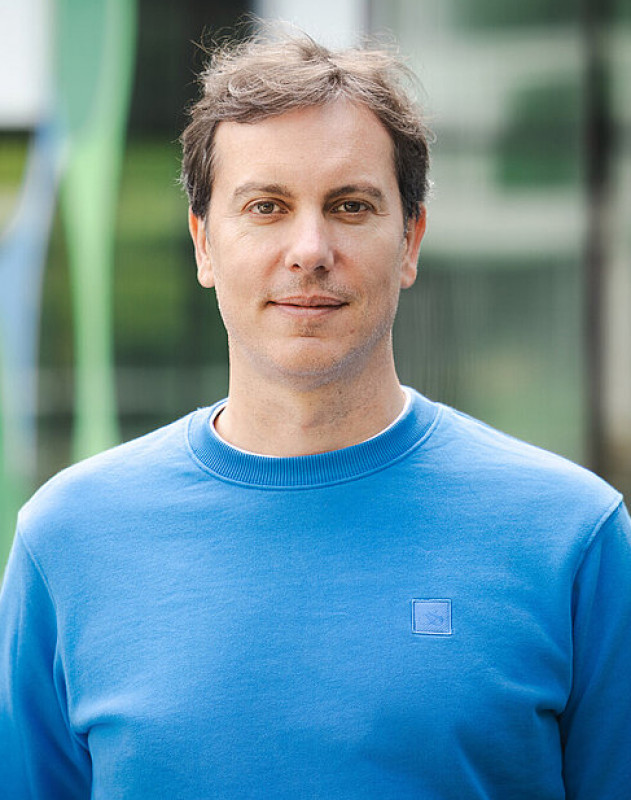
Nicolas Rivron is a group leader at the Institute for Molecular Biotechnology of the Austrian Academy of Sciences (IMBA) in Vienna. He led the development of the first complete blastocyst models, known as blastoids, in mice and humans. His lab uses these models to study embryonic self-organization and the evolutionary origins of human reproductive traits. He co-founded dawn-bio to translate blastoid-based discoveries into medical advances and works closely with ethicists, philosophers, and legal scholars to develop international guidelines for embryo models.
