

KLI Colloquia are invited research talks of about an hour followed by 30 min discussion. The talks are held in English, open to the public, and offered in hybrid format.
Join via Zoom:
https://us02web.zoom.us/j/5881861923?omn=85945744831
Meeting ID: 588 186 1923
Fall-Winter 2026/27 KLI Colloquium Series
1 October 2026 (Thurs) 3-4:30 PM CET 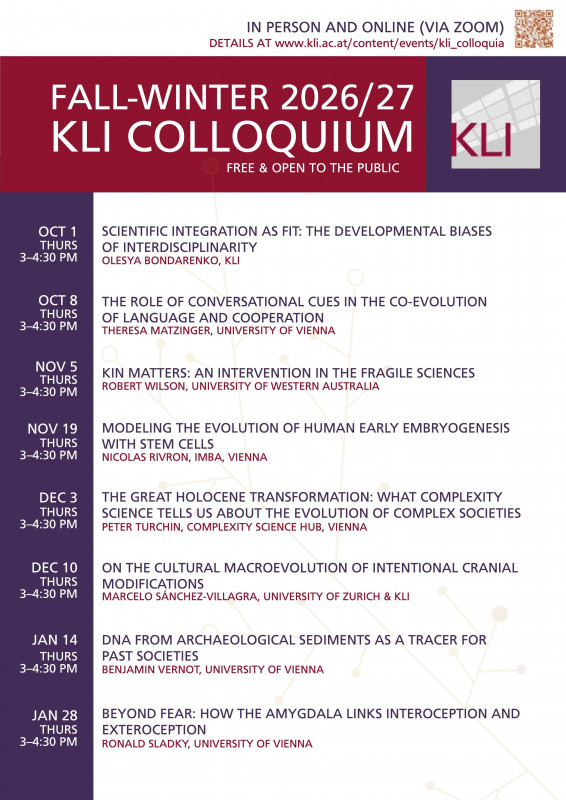
Scientific Integration as Fit: The Developmental Biases of Interdisciplinarity
Olesya BONDARENKO (KLI)
8 October 2026 (Thurs) 3-4:30 PM CET
The Role of Conversational Cues in the Co-Evolution of Language and Cooperation
Theresa MATZINGER (University of Vienna)
5 November 2026 (Thurs) 3-4:30 PM CET
Kin Matters: An Intervention in the Fragile Sciences
Robert A. WILSON (University of Western Australia)
19 November 2026 (Thurs) 3-4:30 PM CET
Modeling the Evolution of Human Early Embryogenesis with Stem Cells
Nicolas RIVRON (Institute of Molecular Biotechnology/IMBA, Vienna)
3 December 2026 (Thurs) 3-4:30 PM CET
Peter TURCHIN (Complexity Science Hub, Vienna)
10 December 2026 (Thurs) 3-4:30 PM CET
On the Cultural Macroevolution of Intentional Cranial Modifications
Marcelo SÁNCHEZ-VILLAGRA (University of Zurich)
14 January 2027 (Thurs) 3-4:30 PM CET
DNA from Archaeological Sediments as a Tracer for Past Societies
Benjamin VERNOT (University of Vienna)
28 January 2027 (Thurs) 3-4:30 PM CET
Beyond Fear: How the Amygdala Links Interoception and Exteroception
Ronald SLADKY (University of Vienna)
KLI Colloquia 2014 – 2026
Event Details
Join Zoom Meeting
https://us02web.zoom.us/j/5881861923?omn=85945744831
Meeting ID: 588 186 1923
Topic description / abstract
Moving beyond traditional gene-centric models, in this talk I argue that traits are not fixed outcomes determined by genes, but dynamic processes shaped by interactions between genetic, developmental, and environmental factors. Drawing on philosophy of biology and EvoDevo, I emphasize the importance of developmental timing, particularly during sensitive periods when the brain exhibits heightened plasticity. Central to this argument is the concept of heterochrony—evolutionary changes in the timing of developmental events—which is used to explain key features of human brain evolution, including the prolonged postnatal development and extended plasticity of the neocortex.
This extended plasticity is presented as a double-edged sword: while it enables adaptability and cognitive diversity in complex environments, it also increases vulnerability to neurodevelopmental disorders. I highlight schizophrenia as a case study, suggesting that abnormal prolongation of plasticity and excessive synaptic pruning may underlie its onset and progression.
Furthermore, I advocate for an interactionist framework that integrates biological and environmental influences across developmental stages. This reconceptualization challenges the traditional “gene-for-trait” paradigm and instead prioritizes the temporal dynamics of development as a key explanatory factor. In conclusion, I calls for a philosophically informed neuroscience that focuses on developmental processes and timing. Such an approach may improve understanding of psychopathology and inform more effective, developmentally targeted interventions.
Biographical note
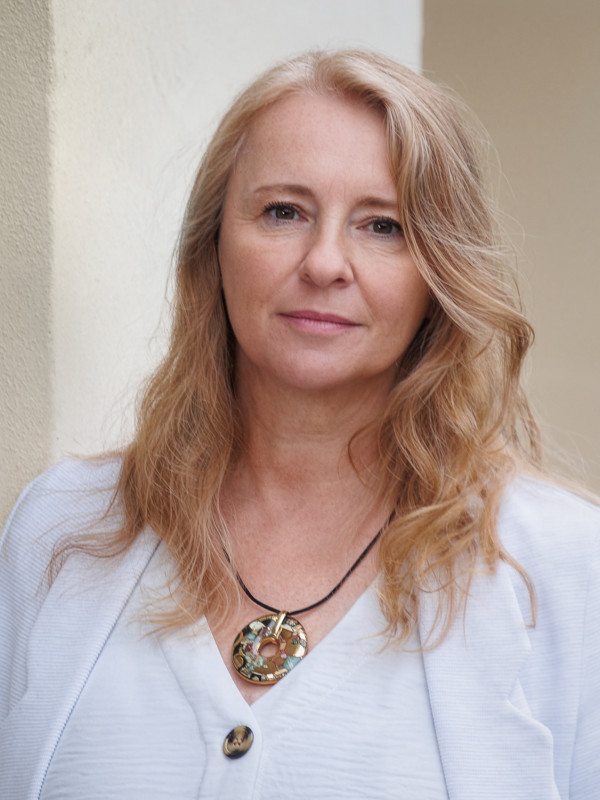
Isabella Sarto-Jackson is a neurobiologist and theoretical biologist. She is Executive Manager and Group Leader at the Konrad Lorenz Institute for Evolution and Cognition Research (KLI) and past president of the Austrian Neuroscience Association. She holds a Master ́s degree in genetics, a PhD in neurobiochemistry, and the venia docendi in neurobiology. She has worked as a Postdoc and Assistant Professor at the Center for Brain Research of the Medical University in Vienna and as a guest researcher at the Leibniz Institute for Neurobiology in Magdeburg. In 2011, she joined the KLI, extending her research focus to philosophy of biology and evolutionary biology. She is Associate Editor of Biological Theory and teaches at the University of Vienna, Medical University of Vienna, and the Comenius University in Bratislava. Her research focuses on interrelations between cognition and evolution drawing on concepts of cognitive biology and evolutionary epistemology that understand knowledge as a biogenic phenomenon involving all levels of biological organization. She is also interested in the processes that lie at the interface of biological and cultural evolution, particularly in the accelerating factors that have contributed to the evolution of the social brain.
Spring-Summer 2026 KLI Colloquium Series
