

KLI Colloquia are invited research talks of about an hour followed by 30 min discussion. The talks are held in English, open to the public, and offered in hybrid format.
Join via Zoom:
https://us02web.zoom.us/j/5881861923?omn=85945744831
Meeting ID: 588 186 1923
Fall-Winter 2026/27 KLI Colloquium Series
1 October 2026 (Thurs) 3-4:30 PM CET 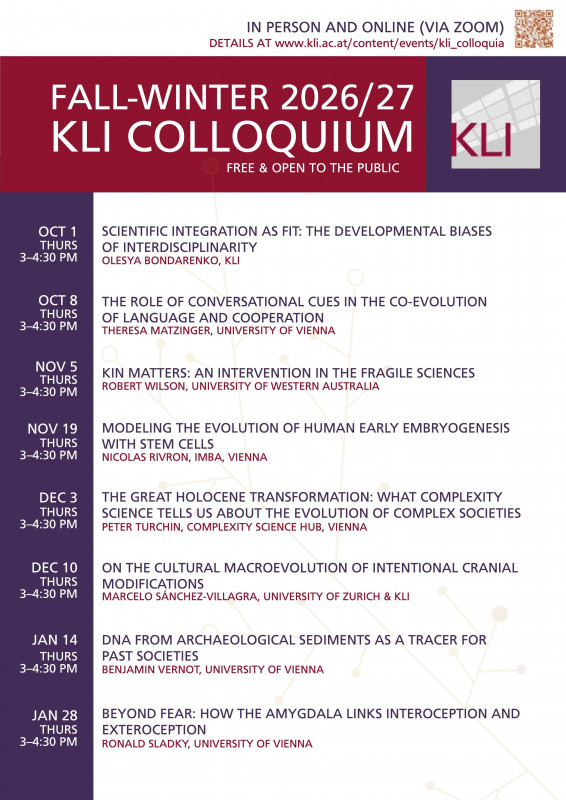
Scientific Integration as Fit: The Developmental Biases of Interdisciplinarity
Olesya BONDARENKO (KLI)
8 October 2026 (Thurs) 3-4:30 PM CET
The Role of Conversational Cues in the Co-Evolution of Language and Cooperation
Theresa MATZINGER (University of Vienna)
5 November 2026 (Thurs) 3-4:30 PM CET
Kin Matters: An Intervention in the Fragile Sciences
Robert A. WILSON (University of Western Australia)
19 November 2026 (Thurs) 3-4:30 PM CET
Modeling the Evolution of Human Early Embryogenesis with Stem Cells
Nicolas RIVRON (Institute of Molecular Biotechnology/IMBA, Vienna)
3 December 2026 (Thurs) 3-4:30 PM CET
Peter TURCHIN (Complexity Science Hub, Vienna)
10 December 2026 (Thurs) 3-4:30 PM CET
On the Cultural Macroevolution of Intentional Cranial Modifications
Marcelo SÁNCHEZ-VILLAGRA (University of Zurich)
14 January 2027 (Thurs) 3-4:30 PM CET
DNA from Archaeological Sediments as a Tracer for Past Societies
Benjamin VERNOT (University of Vienna)
28 January 2027 (Thurs) 3-4:30 PM CET
Beyond Fear: How the Amygdala Links Interoception and Exteroception
Ronald SLADKY (University of Vienna)
KLI Colloquia 2014 – 2026
Event Details
Join Zoom Meeting
https://us02web.zoom.us/j/5881861923?omn=85945744831
Meeting ID: 588 186 1923
Abstract / topic description:
I will be talking about how Vienna became a centre of scientific progress in the late 19th century/early 2th century, and how this impacted on many aspects of the city's cultural, artistic and intellectual life. This led to the development of the "Scientific World View" espoused by the Vienna Circle of philosophers during 1920s, a hallmark of Vienna's contribution to Western intellectual life. I argue that the vitality and importance of this tradition in part explains why the Nazis did their utmost to obliterate Vienna' scientific culture during the 1930s and after. But Vienna also led other centres of scientific excellence in applying theory and ideas to entirely new areas of human endeavour, thus creating the modern "knowledge economy". Appropriately, this was a term coined and popularised by two Viennese, Peter Drucker, the founder of management studies, and the economist Fritz Machlup. Like these two, many Viennese were forced to emigrate from the city in the late 1930s, taking the early building building blocks of the knowledge economy, and the scientific methodology, with them. Thus, in very profound ways, the Viennese world view helped to shape the West during the 20th century.
Biographical note:
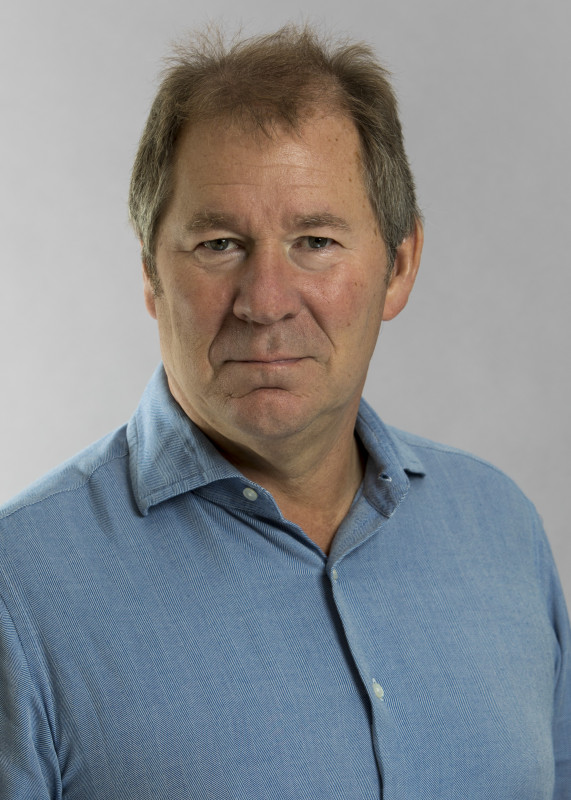
Dr Richard Cockett is a historian, writer and journalist. He is a member of the Institute for Advanced Study, Princeton; a senior editor of The Economist; and the author of "Vienna: How the City of Ideas created the Modern World", published by Yale University Press in 2023. Previously a lecturer in history and politics at the University of London, for The Economist he has reported from Latin America, African and South and South-East Asia. He has written several books on British history and also world affairs. "Vienna" won the Bruno Kreisky prize for political book of the year in 2024, and was also runner-up as Austria's science book of the year in a poll of readers.
