

KLI Colloquia are invited research talks of about an hour followed by 30 min discussion. The talks are held in English, open to the public, and offered in hybrid format.
Join via Zoom:
https://us02web.zoom.us/j/5881861923?omn=85945744831
Meeting ID: 588 186 1923
Fall-Winter 2026/27 KLI Colloquium Series
1 October 2026 (Thurs) 3-4:30 PM CET 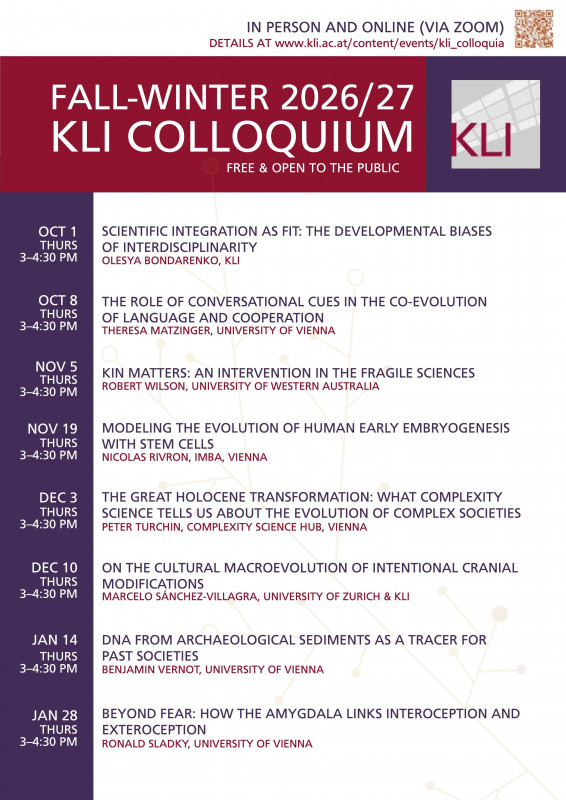
Scientific Integration as Fit: The Developmental Biases of Interdisciplinarity
Olesya BONDARENKO (KLI)
8 October 2026 (Thurs) 3-4:30 PM CET
The Role of Conversational Cues in the Co-Evolution of Language and Cooperation
Theresa MATZINGER (University of Vienna)
5 November 2026 (Thurs) 3-4:30 PM CET
Kin Matters: An Intervention in the Fragile Sciences
Robert A. WILSON (University of Western Australia)
19 November 2026 (Thurs) 3-4:30 PM CET
Modeling the Evolution of Human Early Embryogenesis with Stem Cells
Nicolas RIVRON (Institute of Molecular Biotechnology/IMBA, Vienna)
3 December 2026 (Thurs) 3-4:30 PM CET
Peter TURCHIN (Complexity Science Hub, Vienna)
10 December 2026 (Thurs) 3-4:30 PM CET
On the Cultural Macroevolution of Intentional Cranial Modifications
Marcelo SÁNCHEZ-VILLAGRA (University of Zurich)
14 January 2027 (Thurs) 3-4:30 PM CET
DNA from Archaeological Sediments as a Tracer for Past Societies
Benjamin VERNOT (University of Vienna)
28 January 2027 (Thurs) 3-4:30 PM CET
Beyond Fear: How the Amygdala Links Interoception and Exteroception
Ronald SLADKY (University of Vienna)
KLI Colloquia 2014 – 2026
Event Details

Join Zoom Meeting
https://us02web.zoom.us/j/5881861923?omn=85945744831
Meeting ID: 588 186 1923
Topic description / abstract:
Darwin's finches are undergoing rapid evolutionary and behavioral changes in association with the accidentally introduced avian vampire fly (Philornis downsi). The parasitic fly was first recorded on Santa Cruz, Galapagos, in the 1960s and was first discovered in Darwin's finch nests in 1997. Since then, mortality costs have been high in both finches and flies, which may explain behavioral and genetic changes in both systems. This talk will summarise what we have learned about the co-evolutionary dynamics of this rapidly evolving association over the last 25 years, with a view to informing conservation management approaches on the one hand, and understanding the fundamental biological principles of parasite invasions on the other.
Biographical note:
Sonia Kleindorfer is passionate about understanding animal behavior through the lens of evolutionary biology. Originally from Philadelphia, she began her academic journey at the University of Pennsylvania, where she studied the biological basis of behavior as an undergraduate.
Before enrolling at the University of Vienna for her Ph.D., she spent two years studying baboons in Tanzania. She later completed a postdoctoral fellowship at the University of Washington School of Medicine, still immersed in a baboon world, before transitioning to avian ecology as a model system for her research.
As a field biologist, Sonia has followed in the footsteps of naturalist explorers, inspired by the insights that can be gained from first-hand experience. She has studied behavioral ecology for 30+ years, including several years in the rainforests of Ecuador, several years in the island systems of Papua New Guinea and Fiji, 18 years in the outback and woodland forests of South Australia, and since 2000, maintaining her long-term field site on the Galapagos Islands.
She was professor of biology from 2002 to 2024 at Flinders University in Australia. Since 2018, Sonia is the director of the Konrad Lorenz Research Center for Behavior and Cognition in Grünau im Almtal and professor at the University of Vienna.
