

KLI Colloquia are invited research talks of about an hour followed by 30 min discussion. The talks are held in English, open to the public, and offered in hybrid format.
Join via Zoom:
https://us02web.zoom.us/j/5881861923?omn=85945744831
Meeting ID: 588 186 1923
Fall-Winter 2026/27 KLI Colloquium Series
1 October 2026 (Thurs) 3-4:30 PM CET 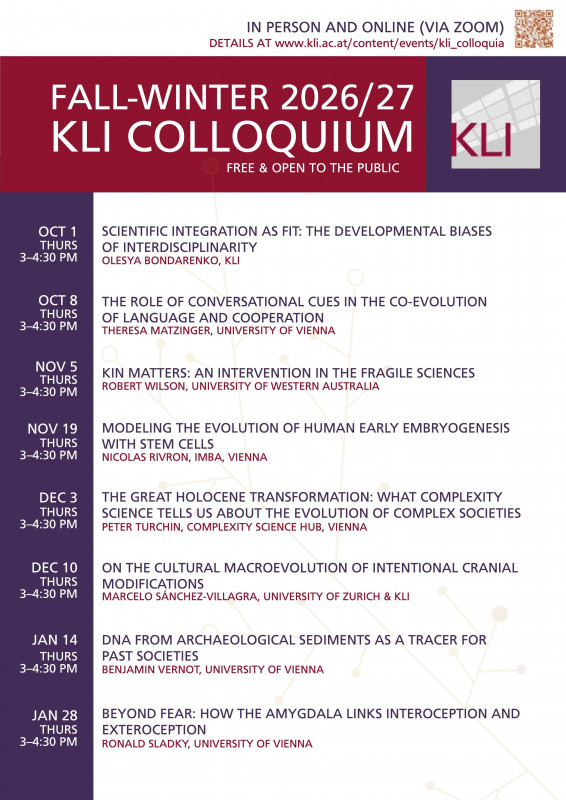
Scientific Integration as Fit: The Developmental Biases of Interdisciplinarity
Olesya BONDARENKO (KLI)
8 October 2026 (Thurs) 3-4:30 PM CET
The Role of Conversational Cues in the Co-Evolution of Language and Cooperation
Theresa MATZINGER (University of Vienna)
5 November 2026 (Thurs) 3-4:30 PM CET
Kin Matters: An Intervention in the Fragile Sciences
Robert A. WILSON (University of Western Australia)
19 November 2026 (Thurs) 3-4:30 PM CET
Modeling the Evolution of Human Early Embryogenesis with Stem Cells
Nicolas RIVRON (Institute of Molecular Biotechnology/IMBA, Vienna)
3 December 2026 (Thurs) 3-4:30 PM CET
Peter TURCHIN (Complexity Science Hub, Vienna)
10 December 2026 (Thurs) 3-4:30 PM CET
On the Cultural Macroevolution of Intentional Cranial Modifications
Marcelo SÁNCHEZ-VILLAGRA (University of Zurich)
14 January 2027 (Thurs) 3-4:30 PM CET
DNA from Archaeological Sediments as a Tracer for Past Societies
Benjamin VERNOT (University of Vienna)
28 January 2027 (Thurs) 3-4:30 PM CET
Beyond Fear: How the Amygdala Links Interoception and Exteroception
Ronald SLADKY (University of Vienna)
KLI Colloquia 2014 – 2026
Event Details

Join Zoom Meeting
https://us02web.zoom.us/j/5881861923?omn=85945744831
Meeting ID: 588 186 1923
Topic description / abstract:
The Red Queen Hypothesis, put forward by biologist Leigh Van Valen in 1973, argues that fitness is not an achievement, but a process. Environments may always change, especially due to the influence of other organisms, and so what is fit today may not be fit tomorrow. Here, I discuss an epistemic analogue to this: that knowledge is also a process, i.e. that previously successful scientific theories or methods may stop being successful due to changes in the world that they study.
I explore and offer examples of three types of such change, with a particular focus on changes instigated by humans: i. activity which undermines previously successful scientific theories; ii. activity which reduces the reliability of scientific methods; and iii. activity which undermines the socio-ecological preconditions for science. In doing so, I draw connections between scientific activity, climate change, other anthropogenic crises, and ultimately between the original and the epistemic formulations of the Red Queen Hypothesis. I finish by exploring the implications of the Epistemic Red Queen Hypothesis, and suggesting that we should be concerned about the possible unproduction of knowledge, and the environmental impacts of scientific research.
Biographical note:
Elis Jones is a philosopher and sociologist focused on scientific practice and values in marine contexts. He is interested in using qualitative and conceptual methods to understand how values (in a broad sense) shape scientific activity, including the influence of personal, social and scientific ideals, but also the value attributed to specific entities, particularly living ones. His BA dissertation, a part of his degree in Politics, Philosophy and Economics, offered a non-anthropocentric definition of environmental damage (i.e. a way to define environmental damage which does not require the existence of humans). His MRes in Science and Technology Studies focused on human bioengineering of corals. His PhD, based at Exeter University’s Egenis Centre, focused on the value attributed to coral reefs by scientists. This work was empirical and conceptual: he interviewed coral scientists and qualitatively analysed interview data alongside scientific literature. The result was a thesis looking at key issues in coral science related to reef value: how ecological baselines (depictions of ‘normal’ or ‘healthy’ reefs) are produced; how intrinsic, instrumental and non-human forms of value interact and are incorporated into scientific activities; and how coral science itself is increasingly evaluated according to the socio-ecological conditions it produces and perpetuates. After finishing his PhD he undertook at short project embedded in a marine biogeochemistry lab (the Betrand Lab at Dalhousie University in Canada), where he explored the concepts underlying the rapidly developing field of marine biogeochemistry, which involves the study of microbes and how they move chemical elements around in the ocean. His postdoctoral work focuses on the ecological, scientific and economic value of marine ecosystems.
His work is interdisciplinary and engaged, borrowing from philosophy, sociology, science and technology studies (STS), economics, ecology, and biogeochemistry. He has worked closely with scientists and engaged with the public, by organising, attending and speaking at events with marine and social scientists, philosophers, arts and humanities scholars, the general public, and school children. More recently, he has co-organised an international workshop, research network, podcast (titled ‘Values at Sea’), and an edited journal volume to foster closer dialogues between STS, philosophy, and marine science.
