

KLI Colloquia are invited research talks of about an hour followed by 30 min discussion. The talks are held in English, open to the public, and offered in hybrid format.
Join via Zoom:
https://us02web.zoom.us/j/5881861923?omn=85945744831
Meeting ID: 588 186 1923
Fall-Winter 2026/27 KLI Colloquium Series
1 October 2026 (Thurs) 3-4:30 PM CET 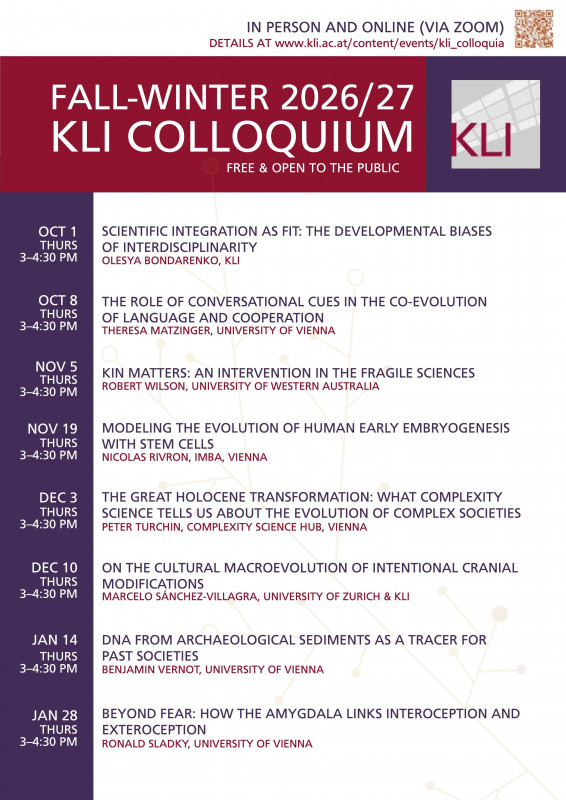
Scientific Integration as Fit: The Developmental Biases of Interdisciplinarity
Olesya BONDARENKO (KLI)
8 October 2026 (Thurs) 3-4:30 PM CET
The Role of Conversational Cues in the Co-Evolution of Language and Cooperation
Theresa MATZINGER (University of Vienna)
5 November 2026 (Thurs) 3-4:30 PM CET
Kin Matters: An Intervention in the Fragile Sciences
Robert A. WILSON (University of Western Australia)
19 November 2026 (Thurs) 3-4:30 PM CET
Modeling the Evolution of Human Early Embryogenesis with Stem Cells
Nicolas RIVRON (Institute of Molecular Biotechnology/IMBA, Vienna)
3 December 2026 (Thurs) 3-4:30 PM CET
Peter TURCHIN (Complexity Science Hub, Vienna)
10 December 2026 (Thurs) 3-4:30 PM CET
On the Cultural Macroevolution of Intentional Cranial Modifications
Marcelo SÁNCHEZ-VILLAGRA (University of Zurich)
14 January 2027 (Thurs) 3-4:30 PM CET
DNA from Archaeological Sediments as a Tracer for Past Societies
Benjamin VERNOT (University of Vienna)
28 January 2027 (Thurs) 3-4:30 PM CET
Beyond Fear: How the Amygdala Links Interoception and Exteroception
Ronald SLADKY (University of Vienna)
KLI Colloquia 2014 – 2026
Event Details

Join Zoom Meeting
https://us02web.zoom.us/j/5881861923?omn=85945744831
Meeting ID: 588 186 1923
Topic description / abstract:
The origin of the nervous system remains one of the most exciting and unsolved questions in animal evolution. How and in what animals did the first neurons come into place? And how did animals progress from a simple nerve net, as is still observed in marine animals such as cnidarians, to the most complex centralized nervous systems and brains, as found for instance in octopus or human?
In recent years, the molecular characterization of neurodevelopment and the sequencing and comparative analysis of cell types in a variety of organisms has yielded compelling new insights into nervous system evolution. Our laboratory is working on several marine animal model systems that are especially suited to infer ancestral states of nervous system complexity: sponges, sea anemone, annelid, amphioxus, lamprey and shark. In my lecture, I will focus on recent results from the marine annelid Platynereis dumerilii to unravel ancestral features that existed in the famous ancestor of animals with bilateral symmetry, the urbilaterian.
These studies have fostered new insights into nervous system origins. Contrary to prevailing views, our data suggest that the first animal cell types had neuron-like communicative properties and subsequently gave rise to non-neuronal cell types (and not vice versa). We also propose that the bilaterian centralized nervous system has evolved from the peptidergic neurosecretory cells of the Ediacaran mucociliary sole together with the enteric nervous system of the gut.Prof. Dr. Detlev Arendt is a group leader and Senior Scientist at the Developmental Biology Unit at the European Molecular Biology Laboratory in Heidelberg and holds a honorary professorship at the Centre for Organismal Studies at Heidelberg University. His laboratory has established the marine annelid Platynereis dumerilii as a molecular model for evolutionary, developmental and neurobiological research, with a major interest in the evolution of animal body plans and nervous systems. He has studied the evolution of photoreceptor cells and pioneered the new field of cell type evolution and development. He has received two consecutive European Research Council Advanced Grants and is a member of the European Molecular Biology Organization and of the Academia Europea.
Biographical note:
Prof. Dr. Detlev Arendt is a group leader and Senior Scientist at the Developmental Biology Unit at the European Molecular Biology Laboratory in Heidelberg and holds a honorary professorship at the Centre for Organismal Studies at Heidelberg University. His laboratory has established the marine annelid Platynereis dumerilii as a molecular model for evolutionary, developmental and neurobiological research, with a major interest in the evolution of animal body plans and nervous systems. He has studied the evolution of photoreceptor cells and pioneered the new field of cell type evolution and development. He has received two consecutive European Research Council Advanced Grants and is a member of the European Molecular Biology Organization and of the Academia Europea.
