
KLI Colloquia are invited research talks of about an hour followed by 30 min discussion. The talks are held in English, open to the public, and offered in hybrid format.
Join via Zoom:
https://us02web.zoom.us/j/5881861923?omn=85945744831
Meeting ID: 588 186 1923
Fall-Winter 2026/27 KLI Colloquium Series
1 October 2026 (Thurs) 3-4:30 PM CET 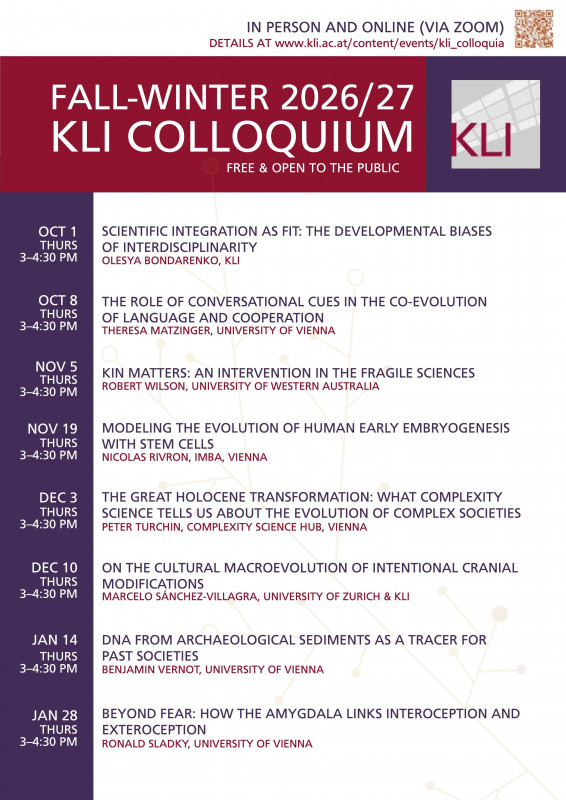
Scientific Integration as Fit: The Developmental Biases of Interdisciplinarity
Olesya BONDARENKO (KLI)
8 October 2026 (Thurs) 3-4:30 PM CET
The Role of Conversational Cues in the Co-Evolution of Language and Cooperation
Theresa MATZINGER (University of Vienna)
5 November 2026 (Thurs) 3-4:30 PM CET
Kin Matters: An Intervention in the Fragile Sciences
Robert A. WILSON (University of Western Australia)
19 November 2026 (Thurs) 3-4:30 PM CET
Modeling the Evolution of Human Early Embryogenesis with Stem Cells
Nicolas RIVRON (Institute of Molecular Biotechnology/IMBA, Vienna)
3 December 2026 (Thurs) 3-4:30 PM CET
Peter TURCHIN (Complexity Science Hub, Vienna)
10 December 2026 (Thurs) 3-4:30 PM CET
On the Cultural Macroevolution of Intentional Cranial Modifications
Marcelo SÁNCHEZ-VILLAGRA (University of Zurich)
14 January 2027 (Thurs) 3-4:30 PM CET
DNA from Archaeological Sediments as a Tracer for Past Societies
Benjamin VERNOT (University of Vienna)
28 January 2027 (Thurs) 3-4:30 PM CET
Beyond Fear: How the Amygdala Links Interoception and Exteroception
Ronald SLADKY (University of Vienna)
KLI Colloquia 2014 – 2026
Event Details
To join the KLI Colloquia via Zoom:
https://us02web.zoom.us/j/86548837670?pwd=AWm1v389npLyoJD5e01a9rjMXD7FP6.1
Meeting ID: 865 4883 7670
Passcode: 342640
Topic description / abstract:
Pregnancy originated repeatedly in vertebrate evolution by co-opting the ancestral postovulatory luteal phase of the ovarian cycle, a physiological phase shared across vertebrate females. Eutherian pregnancy therefore represents a physiological equivalent, a “serial homolog” of the progesterone-dominated luteal phase. The key evolutionary innovation that facilitated the characteristically long eutherian pregnancies was the regulatory decoupling of the pregnant and nonpregnant cycle. Only after the two cycles became separately modifiable, could gestation length increase without deleteriously extending the time to the next fertile phase in nonpregnancy. This setting substantially affected the evolution of mammalian pregnancy and the life history of eutherians. In this talk, I will present some of the main insights about eutherian pregnancies that present themselves when studying pregnancy in the context of non-pregnant cycle. These include evidence that pregnancy length is not a homologous feature across eutherians, and that increase in gestation length was driven by the need to accommodate an increasing body size, once independent evolution of pregnant and non-pregnant cycles became possible. Finally, I will share some thoughts on how eutherian pregnancy relates to other instances of vertebrate viviparity.
Biographical note:
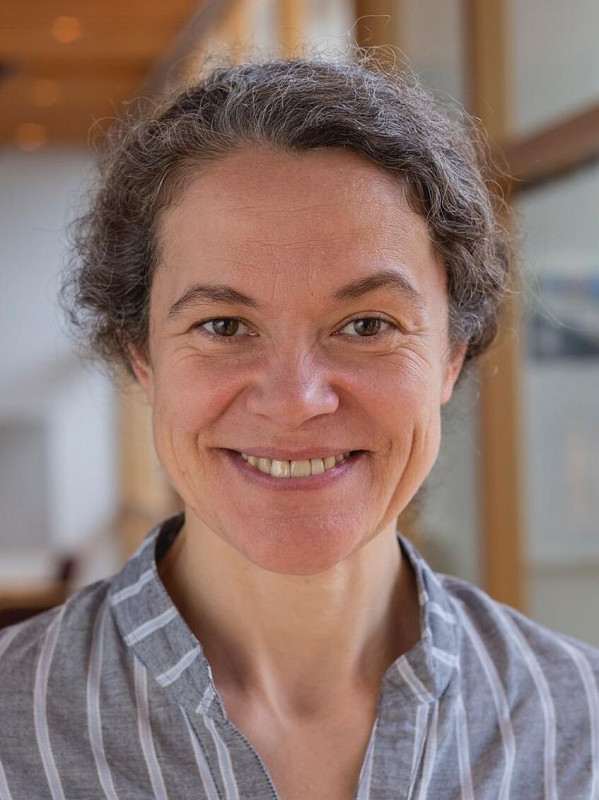
Mihaela Pavlicev is evolutionary biologist broadly interested in the interplay of complex organismal genetic and developmental properties and selection, in determining the evolutionary change and the evolvability of complex characters. Her recent research focuses at various levels of organization, addressing molecular, cellular and tissue evolution, mostly within vertebrate reproduction. She is currently a full professor for Theoretical Evolutionary Biology and a co-chair of the Department of Evolutionary Biology at the University of Vienna.
