

KLI Colloquia are invited research talks of about an hour followed by 30 min discussion. The talks are held in English, open to the public, and offered in hybrid format.
Join via Zoom:
https://us02web.zoom.us/j/5881861923?omn=85945744831
Meeting ID: 588 186 1923
Fall-Winter 2026/27 KLI Colloquium Series
1 October 2026 (Thurs) 3-4:30 PM CET 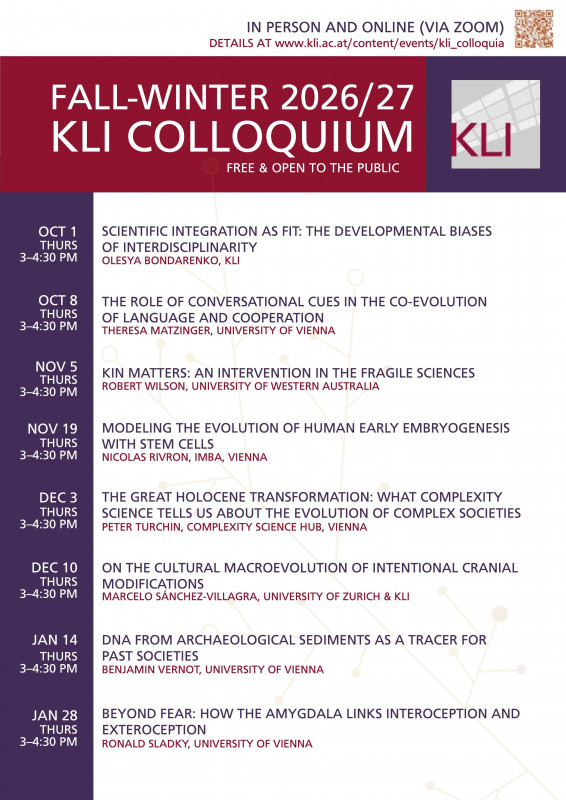
Scientific Integration as Fit: The Developmental Biases of Interdisciplinarity
Olesya BONDARENKO (KLI)
8 October 2026 (Thurs) 3-4:30 PM CET
The Role of Conversational Cues in the Co-Evolution of Language and Cooperation
Theresa MATZINGER (University of Vienna)
5 November 2026 (Thurs) 3-4:30 PM CET
Kin Matters: An Intervention in the Fragile Sciences
Robert A. WILSON (University of Western Australia)
19 November 2026 (Thurs) 3-4:30 PM CET
Modeling the Evolution of Human Early Embryogenesis with Stem Cells
Nicolas RIVRON (Institute of Molecular Biotechnology/IMBA, Vienna)
3 December 2026 (Thurs) 3-4:30 PM CET
Peter TURCHIN (Complexity Science Hub, Vienna)
10 December 2026 (Thurs) 3-4:30 PM CET
On the Cultural Macroevolution of Intentional Cranial Modifications
Marcelo SÁNCHEZ-VILLAGRA (University of Zurich)
14 January 2027 (Thurs) 3-4:30 PM CET
DNA from Archaeological Sediments as a Tracer for Past Societies
Benjamin VERNOT (University of Vienna)
28 January 2027 (Thurs) 3-4:30 PM CET
Beyond Fear: How the Amygdala Links Interoception and Exteroception
Ronald SLADKY (University of Vienna)
KLI Colloquia 2014 – 2026
Event Details

To join the KLI Colloquia via Zoom:
https://us02web.zoom.us/j/86548837670?pwd=AWm1v389npLyoJD5e01a9rjMXD7FP6.1
Meeting ID: 865 4883 7670
Passcode: 342640
Topic description / abstract:
“Life History Theory” (LHT) is an evolutionary concept derived from Behavioral ecology that aims to explore differences between species with regard to a trade-off between reproduction and somatic growth. Accordingly, species differ not just in body size, number of offspring, and lifespan – in fact, these differences co-vary in quite peculiar ways. Indeed, differences in Life History Strategies (LHS) explain between-species variation concerning age at sexual maturation, growth rate, parental investment, mortality rate, immune function, mutation load, and in efficiency of body repair mechanisms.
In the last decades, evolutionary psychology has adopted LHT to suggest that differences in LHS not only exist between species, but among members of the same species, including humans. One of the landmark articles in this regard posited that in human families, harsh environmental contingencies during early developmental stages, including contextual factors such as family discord, poverty etc. may predispose parents to adopt an insensitive, rejecting or inconsistent rearing style, which could impact the child’s view of the world as insecure, thus promoting mistrustful or opportunistic interpersonal behavior. Together, following these lines would increase the likelihood for a “faster” LHS, compared to more secure environmental conditions. However, the adoption of LHT by evolutionary psychology to explain individual differences between members of the same species has raised methodological concerns among evolutionary biologists.
A crucial question for psychiatry is whether the concept of LHT, or its evolutionary psychological derivate, can be meaningfully applied to psychopathological conditions. In the present talk, I will argue that theoretical frameworks, based on evolution by natural and sexual selection, can improve our understanding of the nature of psychopathological conditions, in spite of limitations that are largely associated with disparities between psychological and biological development. LHT, for example, can fruitfully add to insights from attachment theory, which to date is the only evolution-based theory that has prevailed in psychiatry. LHT can also form the basis for empirically testable predictions about comorbidity, and clustering of symptoms, both psychiatric and somatic. If confirmed, LHT may be potentially useful in the domain of preventive medicine, which is highly relevant in light of reduced life expectancy of people with mental disorders.
Biographical note:
Martin Brüne was born in Dortmund, Germany, in 1962. He graduated in medicine at the University of Münster in 1988. He completed his neurology training in 1993, and his psychiatry training in 1995. His subsequent training included a Visiting Research Scientist fellowship at the Centre for the Mind, a joint venture of the Australian National University and University of Sydney. He is currently Professor of Psychiatry and Head of the Division of Social Neuropsychiatry and Evolutionary Medicine at the LWL University-Hospital, Ruhr-University Bochum, Germany.
Dr. Brüne has authored more than 300 articles and book chapters. He has also authored the “Textbook of Evolutionary Psychiatry and Psychosomatic Medicine: The Origins of Psychopathology” (2nd edn. Oxford University Press, 2016). He served as the Editor (together with Prof. Wulf Schiefenhövel) of “The Oxford Handbook of Evolutionary Medicine” (Oxford University Press, 2019), and (together with Profs. Nico Diederichs, Christopher Goetz and Katrin Amunts) of “Evolutionary Roots of Human Brain Diseases” (Oxford University Press, to be released in autumn 2024).
His current clinically oriented research projects include the analysis of social cognition in psychosis and in personality disorders, the association of social cognition with social functioning and nonverbal behaviour, the behavioural performance of psychiatric populations in evolutionary game-theoretical scenarios, the effect of oxytocin on social perception and cognition in psychiatric disorders, nonverbal interaction in therapeutic settings, genetics and epigenetics involved in social interaction, and psychopathology in nonhuman animals.
Dr. Brüne’s research approach is grounded in evolutionary theory, that is, how and why cognition, emotion and behaviour in psychiatric conditions relate to adaptive function of psychological traits.
Dr Brüne is a member of several psychiatric and neuroscientific societies (Deutsche Gesellschaft für Psychiatrie, Psychotherapie und Nervenheilkunde (DGPPN), International Society for Human Ethology (ISHE), Gesellschaft für Anthropologie (GfA), and the International Graduate School of Neuroscience (IGSN), Ruhr-University Bochum.
