

KLI Colloquia are invited research talks of about an hour followed by 30 min discussion. The talks are held in English, open to the public, and offered in hybrid format.
Join via Zoom:
https://us02web.zoom.us/j/5881861923?omn=85945744831
Meeting ID: 588 186 1923
Fall-Winter 2026/27 KLI Colloquium Series
1 October 2026 (Thurs) 3-4:30 PM CET 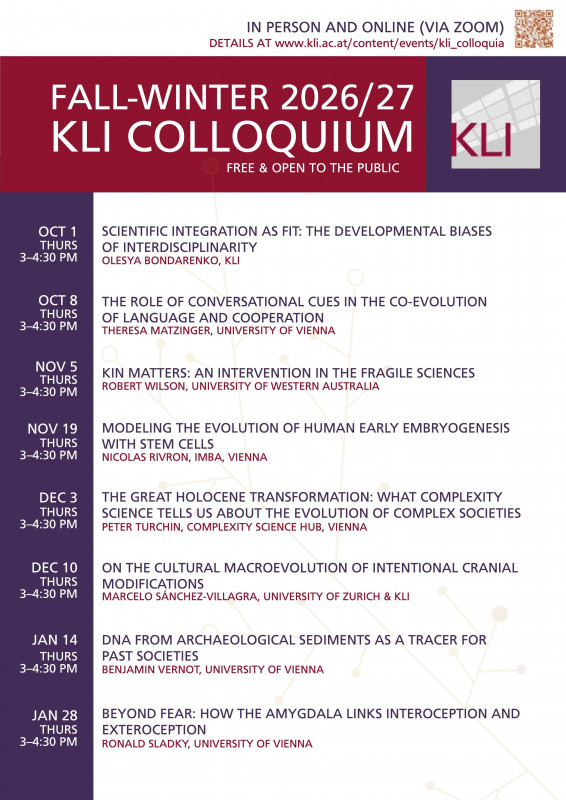
Scientific Integration as Fit: The Developmental Biases of Interdisciplinarity
Olesya BONDARENKO (KLI)
8 October 2026 (Thurs) 3-4:30 PM CET
The Role of Conversational Cues in the Co-Evolution of Language and Cooperation
Theresa MATZINGER (University of Vienna)
5 November 2026 (Thurs) 3-4:30 PM CET
Kin Matters: An Intervention in the Fragile Sciences
Robert A. WILSON (University of Western Australia)
19 November 2026 (Thurs) 3-4:30 PM CET
Modeling the Evolution of Human Early Embryogenesis with Stem Cells
Nicolas RIVRON (Institute of Molecular Biotechnology/IMBA, Vienna)
3 December 2026 (Thurs) 3-4:30 PM CET
Peter TURCHIN (Complexity Science Hub, Vienna)
10 December 2026 (Thurs) 3-4:30 PM CET
On the Cultural Macroevolution of Intentional Cranial Modifications
Marcelo SÁNCHEZ-VILLAGRA (University of Zurich)
14 January 2027 (Thurs) 3-4:30 PM CET
DNA from Archaeological Sediments as a Tracer for Past Societies
Benjamin VERNOT (University of Vienna)
28 January 2027 (Thurs) 3-4:30 PM CET
Beyond Fear: How the Amygdala Links Interoception and Exteroception
Ronald SLADKY (University of Vienna)
KLI Colloquia 2014 – 2026
Event Details

Topic description / abstract:
The evolutionary role of environmentally induced phenotypic variation, i.e. environmental plasticity, is an important issue in developmental evolution. One of the major physiological responses to environmental changes is cellular stress, which is counteracted by a generic stress reaction detoxifying the cell, refolding proteins, and repairing eventual DNA damage. In this contribution I will elaborate on a previous finding suggesting that the cell differentiation cascade of human decidual stromal cells, a cell type critical for embryo implantation and the maintenance of pregnancy, evolved from a cellular stress reaction. These results suggest that the stress reaction in these cells was ancestrally elicited by the inflammation caused by embryo attachment and invasion. This leads to a scenario, Stress Induced Evolutinoary Innovation (SIEI), in which the ancestral stress reaction was transformed into the phenotype of a novel cell type, the decidual stromal cell. I will be arguing that SIEI is a distinct form of plasticity based evolutionary change. The distinguishing feature being that SIEI leads to novel cell types, rather than directly to the adaptive transformation of a pre-existing character. The similarities and differences of SIEI and he “plasticity first hypothesis” of evolution will be discussed.
Biographical note:
Günter Wagner is the Alison Richard Professor of Ecology and Evolutionary Biology at Yale University. He is a chemical engineer by training and studied zoology and mathematics at the University of Vienna where he earned a Ph. D. in zoology. From 1985 till 1991 he was at the Department of Zoology at the University of Vienna, Austria and in 1991 joined Yale’s Department of Biology. In 1997 he became the first chair of Yale’s Department of Ecology and Evolutionary Biology. Since 2010 he is a member of the Yale Systems Biology Institute. His research interests include population genetics, the evolution of gene regulation, the evolution of pregnancy, and the evolutionary medicine of cancer and female sexuality. GPW is a Mac Arthur Fellow, member of the US National Academy of Sciences, the American Academy of Arts and Sciences and a corresponding foreign member of the Austrian Academy of Sciences.
